Parts Cut and Welded to Your Drawing or Sketch
Custom metal fabrication in Spartanburg for one-off brackets, mounts, and guards built to fit existing equipment
A cracked mounting bracket on a piece of production equipment, a guard that no longer fits after a machine was modified, a replacement structural tab that the original manufacturer stopped supplying — these are the jobs where hauling the whole machine to a shop is either impractical or impossible. Weld Source Mobile Welding takes custom metal fabrication work for exactly those situations: steel and stainless cut and welded to a customer's drawing, sketch, or set of measurements, either in the shop or on site at the property. The owner is a licensed, insured welder who does the fabrication himself, and he works with small and medium runs where a production shop would turn the job away.
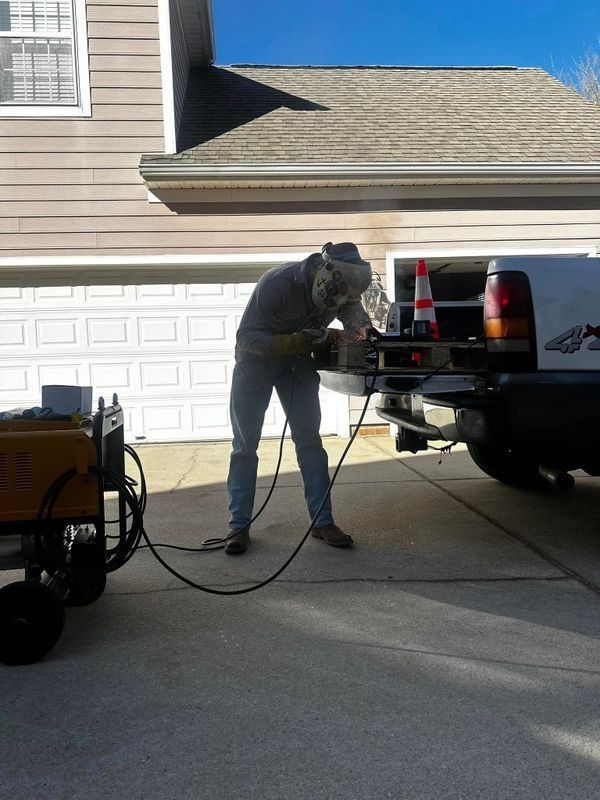
The process starts with what you can provide — a sketch, a photograph, or the dimensions of the existing part. The owner confirms material selection, wall or plate thickness, and whether the finish needs to be ground smooth or left as-welded based on where the part will be used. He then cuts and fits the pieces, welds them, and grinds the finished surfaces to the tolerance the application requires. For farms and equipment shops in areas like Pacolet and Wellford, where a machine breakdown means a production stop, fabricating on site means the fit can be confirmed before the job closes rather than discovering a clearance problem after the part has been driven back from a shop.
Send Weld Source Mobile Welding a photo, sketch, or measurements to confirm whether shop fabrication or an on-site fit is the right approach for your part.
The Difference Between a Shop Run and a One-Off Fit
One-off fabrication is a different discipline from production work. A production run is dimensioned from a clean drawing with known tolerances; a one-off replacement part is dimensioned from an existing machine that may have worn, shifted, or been modified since it left the factory. The owner confirms the reference dimension from the actual mounting point, not from whatever specification the original part carried, because a bracket that was machined to a half-inch tolerance in 2002 may be sitting in a hole that has been redrilled at least once since then.
Once the part is fabricated and fitted, what you have is a component that installs without shimming, sits flush at its contact surfaces, and carries load in the orientation it was designed for. Weld Source Mobile Welding fits parts on site where the geometry allows, so any adjustment is made before the weld is finished rather than after the part is back in the shop. The alternative — fabricating to paper dimensions and returning for a second visit — is the more expensive outcome for both sides, and it is avoided by confirming the fit against the actual machine during the job.
Material selection affects how the finished part performs over time. Carbon steel is appropriate for most structural and load-bearing applications; stainless is specified where corrosion exposure is a factor or where the environment requires it. The owner will flag if a requested material is a mismatch for the application before fabrication starts, which is the kind of decision that does not get made when a job is ordered remotely from a drawing alone.
Common Questions About the Work
These questions address how custom fabrication jobs are scoped, how parts are fitted, and what affects the quality of the finished piece.
What information do you need to start a fabrication job?
A sketch, photograph, or the actual part — along with the mounting location dimensions — is enough to confirm material, thickness, and whether on-site fitting is needed before the owner quotes the job.
How does on-site fitting change what the finished part looks like?
Fitting on site means the part is test-placed in the actual mounting location before the final weld is closed, so clearances to adjacent components are confirmed under real conditions rather than estimated from a drawing.
Why does wall thickness matter for a replacement bracket or mount?
Undersizing the wall thickness on a load-bearing tab concentrates stress at the weld toe, which is where fatigue cracks typically start on parts that carry repeated or impact loading.
What does a ground-smooth weld finish accomplish that an as-welded surface does not?
Grinding removes the weld bead profile and the heat-affected surface scale, which matters on parts that move against other components, carry sliding contact, or need to be painted or coated after installation.
How are one-off fabrication jobs handled differently for older Spartanburg farm equipment versus newer commercial machinery?
Older equipment often has hand-fitted original parts with dimensions that drifted during manufacture, so the owner measures from the actual mounting geometry rather than assuming the nominal specification is accurate.
Weld Source Mobile Welding also handles custom metal fabrication in Greenville, Gaffney, Inman, Union, and Rock Hill. Call (864) 357-8278 to discuss your part and confirm whether shop or on-site fabrication fits the job.