
Handrails Anchored to Steps That Were Never Built for Them
Custom handrails in Spartanburg for older stoops, porch steps, and basement stairs without code-compliant rails
Concrete stoops and porch steps on older Spartanburg homes were poured without any provision for a rail — no embedded anchor, no blocking, no sleeve. Adding a handrail to that kind of construction means drilling into cured concrete or masonry and anchoring a base plate in a way that will hold under a person's full body weight mid-stride. Weld Source Mobile Welding fabricates and installs custom handrails exactly for that situation. The owner is a licensed, insured welder who builds each rail himself and installs it personally at the property, which means the same person who welded the rail sets the anchors and checks the finished installation.
The process begins with measuring the stair run and rise, then confirming the height the rail needs to reach against the applicable code requirement for that application. The sections are fabricated to those numbers, and when the owner returns to install, the bases are anchored into concrete, masonry, or framing depending on what the stair was built on. Welds are finished and ground smooth after assembly so there are no sharp edges or weld spatter left exposed where a hand would grip or slide. For Boiling Springs properties where newer construction sits alongside homes built decades earlier, the substrate under the steps varies considerably — what looks like a concrete stoop from the outside may be a thin slab over block, and the anchor depth and hardware selection change accordingly.
Arrange a measurement visit with Weld Source Mobile Welding to confirm what your steps are built on and what anchoring approach will work before fabrication begins.
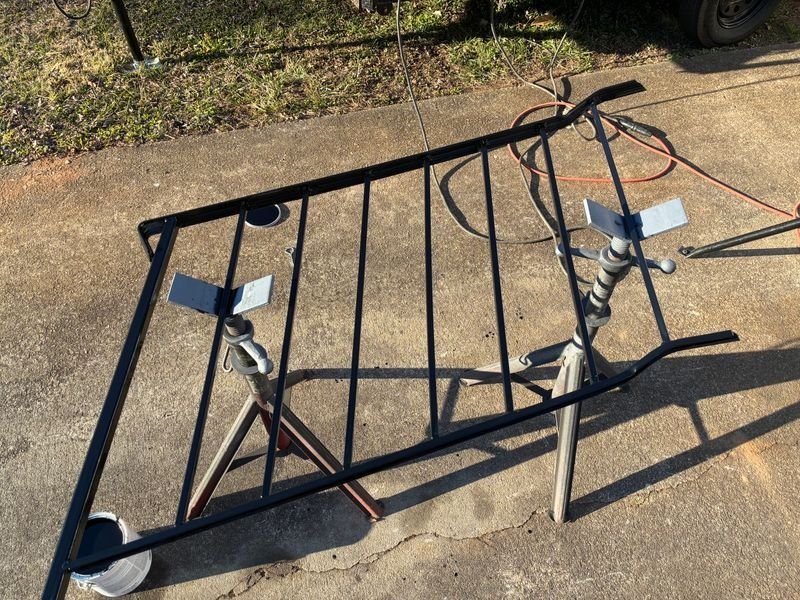
How Handrail Fabrication Addresses Older Stair Conditions
Rails can be fabricated to match an existing railing on the property or designed new from a measurement of the stair. Where a matching rail is needed — a second side of a staircase, for example — the owner takes a profile of the existing rail and replicates the height, spacing, and any decorative detail so the finished pair reads as a set. Where the rail is new, the design is kept functional and clean, with post spacing selected to prevent deflection under lateral load, which is the failure mode that makes an installed rail feel loose before it ever pulls out of the anchor.
Once the installation is complete, the rail is rigid at every post, smooth along its full length, and set at the correct height for the number of risers it serves. In older Converse-area homes with basement stair entries, the stair geometry often includes tighter turns and lower ceiling clearance than a standard exterior stoop, and the rail sections have to be fabricated in shorter runs that can be maneuvered into place and welded on site rather than brought in as a single assembled piece. Weld Source Mobile Welding accounts for that access constraint during the measurement stage.
Handrail work covers the fabrication of the rail sections, the base plates, and the installation into the substrate at the property. Where the substrate condition requires a core sample or additional anchoring hardware — longer anchor bolts, epoxy setting, or surface-mount versus through-bolt plates — that determination is made on site during the measurement visit before any material is ordered.
Answers About How the Work Is Done
These questions address the fabrication and installation process for custom handrails, including how substrate conditions, stair geometry, and code requirements affect the work.
How does the measurement visit determine what anchoring hardware is needed?
The owner checks what the step or landing is constructed from — poured concrete, block, brick, or wood framing — and selects anchor bolt length, diameter, and setting method based on the pull-out load required for that substrate.
What finishing is done to the welds on a handrail?
After the sections are assembled and welded, the welds are ground smooth and any spatter is removed so the finished surface is continuous along the grip line — a weld bead left unground can catch skin on a handrail in a way it would not on a structural member.
Why does the rise-to-run ratio of the stair affect rail height?
Rail height is measured vertically from the nosing of the step, not along the slope of the stringer, so a steeper stair requires the rail post heights to be calculated individually rather than cut to a uniform length.
What happens when an older Spartanburg home has a stoop that was poured in sections at different times?
The anchor locations have to be placed in sections that are sound and continuous, which the owner checks by probing during the measurement visit rather than assuming the slab is uniform throughout.
How is the finished rail checked before the job closes?
The owner applies lateral and downward load at each post, checks that no post deflects or rotates at its base, and runs a hand along the full grip surface to confirm there are no edges remaining.
Weld Source Mobile Welding also installs custom handrails in Greenville, Gaffney, Inman, Union, and Rock Hill. Call (864) 357-8278 to set up a measurement visit and review your stair conditions before any material is cut.